
Blog
What Does Men’s Salwar Kameez Mean: Full Guide


Men’s salwar kameez is a traditional two-piece outfit combining salwar (loose trousers) and kameez (a long tunic), worn by men across South Asia and Central Asia as everyday dress, formal wear, and ceremonial attire. The Cambridge Dictionary defines salwar kameez as a suit with loose pants and a long shirt, though its cultural reach extends far beyond any single dictionary entry. This outfit is not a relic of the past. It is a living, breathing symbol of identity, comfort, and heritage that millions of men wear daily from Lahore to Melbourne.
What does men’s salwar kameez mean as an outfit?
Men’s salwar kameez is defined as a matched set of loose trousers and a long tunic, worn together as a single coordinated outfit. The name itself tells you exactly what you are looking at. Wikipedia describes salwar as trousers wide at the waist and narrow at the cuff, while kameez refers to the long shirt or tunic worn over them. Together, the two pieces form one of the most recognized traditional garments in the world.
The salwar portion sits at the waist with pleats or a drawstring, then tapers toward the ankle. This cut gives the wearer freedom of movement while maintaining a clean silhouette. The kameez falls anywhere from hip length to below the knee, depending on regional tradition and personal preference.
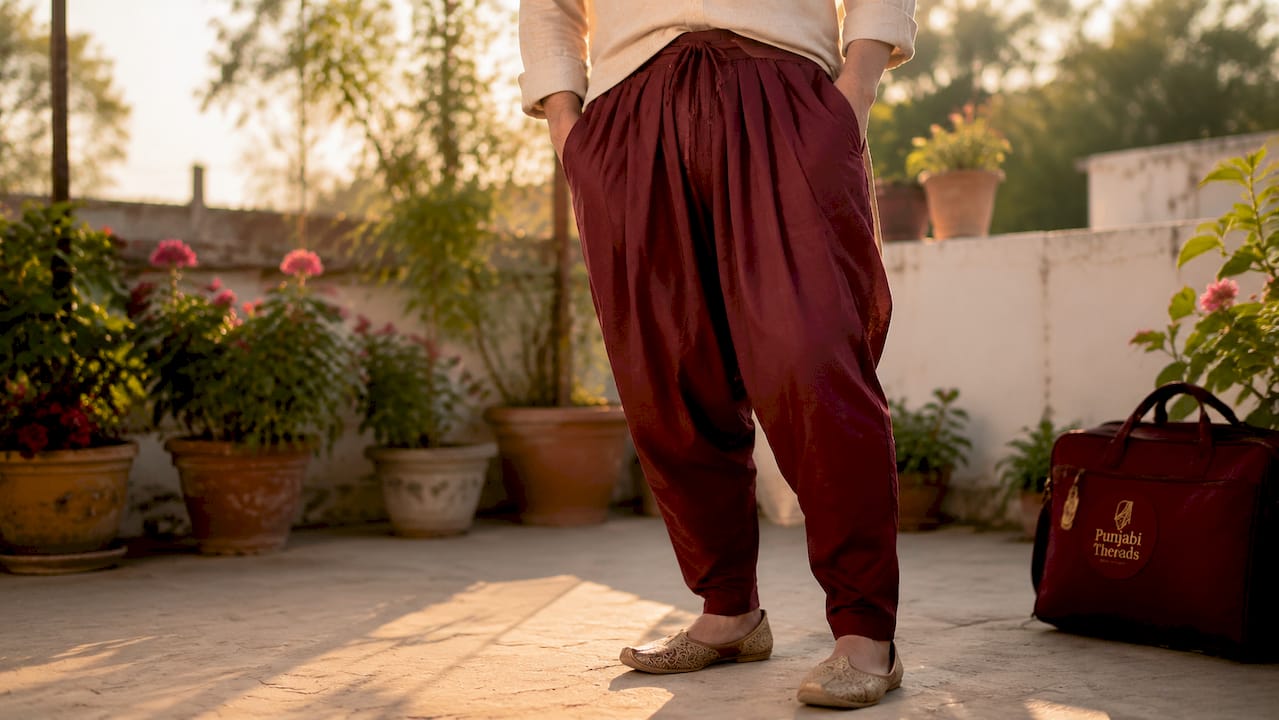
One structural detail that sets the men’s kameez apart from a standard shirt is the chaak. The chaak is an open side seam running from the hip downward, which allows the fabric to flow naturally when walking or sitting. This is not decorative. It is a functional design choice that makes the garment genuinely comfortable for extended wear.
Key components of the outfit include:
- Salwar: Loose, pleated trousers that taper at the ankle, secured at the waist with a drawstring or elastic
- Kameez: A long tunic ranging from hip to knee length, with collar and sleeve variations depending on style
- Chaak: Open side seams on the kameez that improve movement and drape
- Dupatta: A long scarf occasionally included in sets, though far more common in women’s versions of the outfit
Pro Tip: When buying a men’s salwar kameez, check whether the chaak is stitched closed or left open. An open chaak is the traditional cut and gives the kameez its characteristic drape when you move.
How does men’s salwar kameez reflect cultural and historical significance?
The history of men’s salwar kameez runs directly through the Mughal Empire and the Persian and Arabic languages that shaped South Asian culture for centuries. The word salwar derives from Persian, meaning loose trousers, while kameez traces back to Arabic, where it means shirt or tunic. DBS Fashion traces these origins to Persian and Arabic linguistic roots, which reflects how trade, conquest, and cultural exchange shaped the clothing of an entire region.
The outfit became deeply embedded in South Asian identity over several centuries. In Pakistan, the salwar kameez functions as a national dress, worn by men in government offices, schools, and mosques. In India, it carries strong regional associations, particularly in Punjab, Sindh, and the northwestern states. Across Afghanistan, Bangladesh, and parts of Central Asia, variations of the same garment appear under different local names.
A persistent misconception is that salwar kameez belongs exclusively to women. Wikipedia confirms that shalwar kameez is a traditional dress worn by both men and women across the region. The confusion likely stems from Western exposure to the garment through women’s fashion, where embroidered and brightly colored versions dominate. Men’s versions tend toward solid colors, subtle patterns, and simpler embellishment, which makes them less visually prominent in global fashion media.
Regional identity runs deep in how the outfit is worn:
- Punjab (India and Pakistan): Men favor a straight-cut kameez with a wide salwar, often in cotton or linen for daily wear
- Sindh and Balochistan: The shalwar tends to be wider and more voluminous, reflecting local tailoring traditions
- Afghanistan: The perahan tunban is the Afghan variant, with a longer kameez and very wide trousers
- Central Asia: Variations appear in Uzbekistan and Tajikistan, where the tunic style reflects Persian influence
“The salwar kameez is not simply clothing. It is a statement of belonging, a way of saying: I come from this place, this culture, this history.”
The outfit also carries religious significance for many wearers. In Muslim-majority communities across South Asia, the salwar kameez is considered modest, appropriate dress for prayer and religious gatherings. This connection between faith, culture, and clothing reinforces why the garment has remained central to men’s wardrobes for generations.
What are the stylistic variations and modern adaptations in men’s salwar kameez?
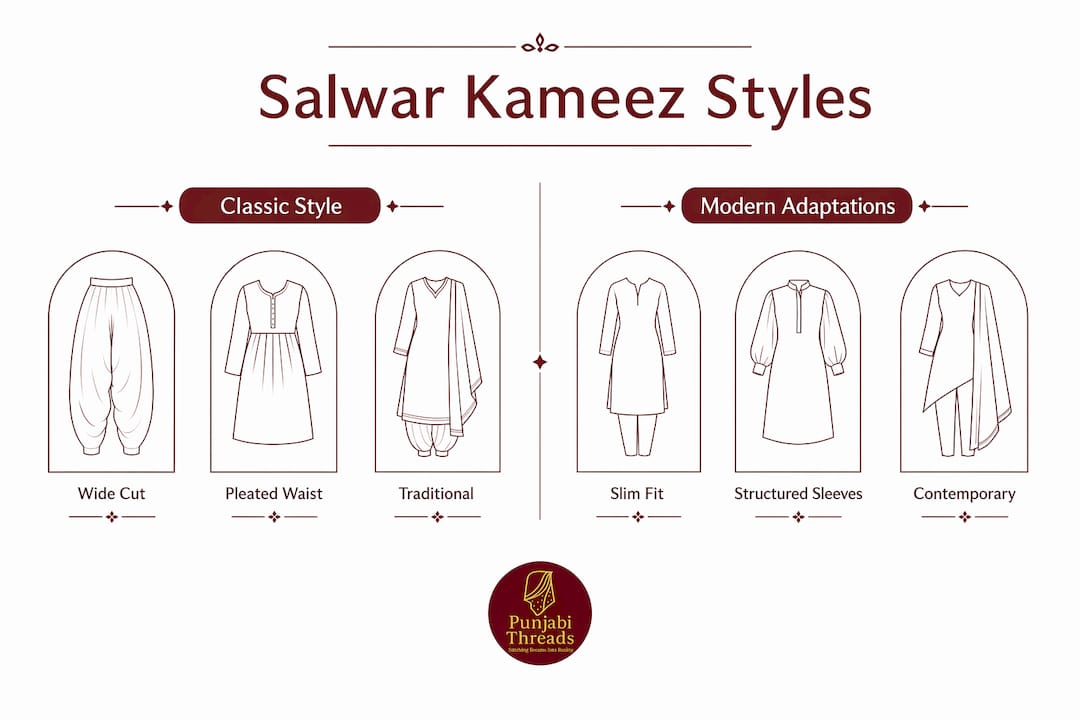
Styles of men’s salwar kameez range from traditional wide-cut regional designs to slim-fit urban versions influenced by contemporary tailoring. Wikipedia and fashion sources describe variations including modern European-style collars, structured cuts, and fusion styles that blend South Asian tradition with Western silhouettes. The result is a garment that works equally well at a village wedding in Lahore and a formal dinner in Melbourne.
The table below summarizes the key differences between classic and modern style elements:
| Element | Classic style | Modern adaptation |
|---|---|---|
| Salwar cut | Wide, pleated, voluminous | Slim or tapered, minimal pleating |
| Kameez length | Below knee, straight hem | Hip to mid-thigh, curved hem |
| Collar style | Mandarin or no collar | Band collar, spread collar, or Nehru collar |
| Fabric | Cotton, linen, or handwoven cloth | Blended fabrics, linen-cotton, or structured suiting |
| Embellishment | Minimal or none | Subtle embroidery at collar and cuffs |
| Occasion | Daily wear, prayer, community events | Weddings, formal dinners, cultural festivals |
The suthan is worth distinguishing from the standard salwar. A suthan is a tighter, more fitted trouser variant common in certain regions of Pakistan and India, while the classic salwar maintains its characteristic loose drape. Both pair with a kameez, but the suthan creates a noticeably sleeker silhouette.
Modern tailors in cities like Karachi, Delhi, and Melbourne now offer structured kameez cuts with set-in sleeves rather than the traditional dropped-shoulder construction. This change makes the kameez sit closer to the body and read as more formal in Western contexts, without abandoning the garment’s cultural identity.
Pro Tip: For weddings and formal events, choose a kameez in silk, raw silk, or structured cotton with a Nehru collar and minimal embroidery at the neckline. This reads as formal in both South Asian and Western social settings without requiring a sherwani.
How is men’s salwar kameez worn across daily and special occasions?
Salwar kameez functions as casual wear on its own, but transitions to formal attire when paired with the right accessories and fabrics. This flexibility is one of the garment’s defining strengths. A plain cotton salwar kameez worn with sandals is appropriate for a Friday prayer or a trip to the market. The same silhouette in embroidered silk, worn with a Nehru jacket and dress shoes, works for a wedding reception.
The practical advantages of the outfit explain its endurance across climates and generations. The loose cut of both the salwar and kameez allows air circulation, making the outfit well-suited to the heat of South Asian summers. The outfit’s loose and comfortable design supports its enduring popularity, especially in hot climates. For diaspora communities in Australia, the UK, and North America, this comfort factor matters just as much as cultural identity.
Ways men wear salwar kameez across different contexts:
- Daily wear: Plain cotton or linen in neutral tones, worn with sandals or simple shoes for comfort and ease
- Friday prayers and religious occasions: Clean, pressed cotton in white or light colors, often with a taqiyah or prayer cap
- Weddings and celebrations: Embroidered silk or brocade kameez with a matching or contrasting salwar, paired with a Nehru jacket or sherwani
- Cultural festivals: Regional styles that reflect specific community heritage, such as Punjabi phulkari embroidery or Sindhi mirror work
- Professional settings: Structured cotton or linen kameez in solid colors, worn as an alternative to a Western business shirt in South Asian workplaces
In multicultural settings like Melbourne, wearing a salwar kameez to a community event, a cultural festival, or a family gathering signals cultural pride without requiring any explanation. The garment communicates identity clearly and confidently on its own. You can explore dhoti style salwar variations if you want to understand how the trouser component itself can shift the entire character of the outfit.
Key takeaways
Men’s salwar kameez is a two-piece traditional outfit with Persian and Arabic roots, worn across South Asia for daily, religious, and ceremonial occasions, and it adapts to modern contexts through tailoring and fabric choices.
| Point | Details |
|---|---|
| Definition of the outfit | Salwar (loose trousers) and kameez (long tunic) form one coordinated traditional ensemble. |
| Etymology and origins | Salwar derives from Persian; kameez from Arabic, reflecting Mughal-era cultural exchange. |
| Not only women’s wear | Men across South Asia and Central Asia wear salwar kameez as standard traditional dress. |
| Chaak design feature | Open side seams on the kameez provide functional movement, especially noticeable when walking. |
| Occasion flexibility | Plain cotton works for daily wear; embroidered silk with a Nehru jacket suits formal events. |
Why the salwar kameez deserves more respect than it gets
Working with traditional South Asian garments at Punjabithreads, I have seen how often the salwar kameez gets reduced to a costume in Western fashion conversations. People treat it as something you wear to a cultural event and then put away. That framing misses the point entirely.
The men who wear salwar kameez daily are not making a fashion statement. They are wearing the most practical, comfortable, and culturally coherent clothing available to them. The chaak detail alone is a piece of functional design that most Western trousers have never matched. The loose salwar cut handles heat, movement, and extended sitting better than any pair of tailored trousers I have encountered.
What I find most interesting is how the garment absorbs modernity without losing itself. A slim-cut kameez in structured linen with a band collar looks current in 2026, but the structural logic of the outfit is unchanged from what men wore in Lahore three centuries ago. That kind of design continuity is rare. It tells you the original solution was genuinely good.
For diaspora communities in Melbourne and beyond, the salwar kameez carries something that no Western garment can replicate. It connects the wearer to a specific place, language, and lineage. Wearing it is an act of memory as much as an act of dressing. I encourage anyone curious about South Asian fashion to look at this garment not as ethnic wear but as one of the world’s most refined and enduring clothing traditions.
— Punjabi
Explore authentic men’s salwar kameez at Punjabithreads
Punjabithreads offers a curated selection of traditional and contemporary men’s salwar kameez, stitched to your exact measurements in Melbourne. Every garment is cut from your chosen fabric and tailored to your proportions, which means the chaak sits correctly, the kameez falls at the right length, and the salwar tapers precisely at your ankle.
Ready-made options rarely account for the fit variations that make a salwar kameez genuinely comfortable. Custom stitching solves that problem directly. Browse the full men’s wear collection at Punjabithreads to find traditional cuts, modern adaptations, and occasion-specific styles. For a broader look at available fabrics and suit options, the Punjabi suits in Melbourne page covers stitched and unstitched options across the full range.
FAQ
What does men’s salwar kameez mean?
Men’s salwar kameez is a traditional South Asian outfit combining salwar (loose, tapered trousers) and kameez (a long tunic), worn by men across South Asia and Central Asia for daily, religious, and formal occasions.
Is salwar kameez only for women?
No. Shalwar kameez is worn by both men and women across South Asia and Central Asia. The misconception that it is women’s clothing comes from Western exposure to heavily embroidered women’s versions.
What is the difference between salwar and shalwar?
Shalwar and salwar are interchangeable spellings for the same garment. The spelling varies by region and language transliteration but refers to the identical trouser component of the outfit.
What is the chaak in a men’s kameez?
The chaak is an open side seam on the lower portion of the kameez that allows the fabric to move freely when walking or sitting. It is a functional design feature, not decorative, and is standard in traditional men’s kameez construction.
Can men wear salwar kameez to formal events?
Yes. A salwar kameez in silk or structured fabric, paired with a Nehru jacket or sherwani, is appropriate for weddings, religious ceremonies, and formal dinners. Salwar kameez becomes formal through fabric choice and accessories rather than a change in the garment’s basic structure.


