
Blog
Sleeve Styles for Punjabi Kameez: 2026 Guide


The sleeve on a Punjabi kameez is rarely just a sleeve. It frames the arm, sets the mood of the entire outfit, and often signals whether you’re dressed for a Tuesday errand or a Saturday wedding. Sleeve styles for Punjabi kameez have evolved dramatically, from the full-length embroidered classics worn at Punjabi celebrations to sheer cutout designs making bold statements on modern runways. Whether you’re shopping unstitched fabric or ordering a custom suit, understanding your sleeve options before you commit means the difference between an outfit you love and one you tolerate.
Table of Contents
- Key Takeaways
- 1. What to consider before choosing sleeve styles for Punjabi kameez
- 2. Classic and traditional sleeve styles
- 3. Modern and trendy sleeve styles
- 4. Sleeve style comparison at a glance
- 5. How to choose the best sleeve style for your kameez
- 6. My honest take on sleeves as a fashion statement
- Explore Punjabithreads’ custom sleeve designs
- FAQ
Key Takeaways
| Point | Details |
|---|---|
| Sleeves carry the outfit | Sleeves are the statement element in Punjabi kameez design, making them the smartest place to take a fashion risk. |
| Occasion shapes the choice | Simpler sleeves suit daily wear, while ornate or embellished options belong at weddings and festive events. |
| Fit outranks style | Poor sleeve fit ruins even the most beautiful design; tailoring the armhole and length is non-negotiable. |
| Volume needs balance | High-volume sleeves work best when the body of the kameez stays clean and understated. |
| Fabric and embellishment connect | The sleeve’s material and decoration should complement the garment’s fabric weight, not fight against it. |
1. What to consider before choosing sleeve styles for Punjabi kameez
Before you fall in love with a design on Instagram, there are a few practical criteria worth running through. Getting this right saves you from a beautiful suit that sits unworn in your wardrobe.
- Occasion and formality. Occasion-driven sleeve choices matter more than most people realize. A heavily embroidered velvet sleeve at Lohri works perfectly; that same sleeve on a summer afternoon outing looks out of place and feels unbearable.
- Fabric compatibility. Chiffon sleeves carry light hand embroidery beautifully without stiffening. Heavy silk or brocade sleeves demand a simpler cut or they overwhelm the arm. Chiffon sleeves work best with delicate embellishment to preserve softness and mobility.
- Arm proportions. Volume sleeves flatter slim arms but may overwhelm shorter or fuller arms. Fitted sleeves draw the eye to the wrist, which works well with cuff embellishments and statement bangles.
- Dupatta draping style. If you drape your dupatta over one shoulder, that sleeve will often be hidden. Spending heavily on embellishment on both sleeves when one stays covered is worth reconsidering.
- Tailoring allowance. Ready-made kameez almost always need sleeve length adjustment. Sleeve length adjustments are almost always required for a polished, proportional fit, so budget for that alteration from the start.
Pro Tip: When getting a kameez stitched, finalize your sleeve length after a fitting session rather than from measurements alone. The difference between “looks right on paper” and “looks right on you” often comes down to those final centimeters at the wrist.
2. Classic and traditional sleeve styles
Traditional Punjabi kameez sleeves carry decades of craft and cultural memory. These are the ones that feel immediately recognizable at family gatherings, gurdwara functions, and wedding celebrations.
Bell sleeves are the most beloved traditional choice. They start fitted at the shoulder and flare dramatically at the wrist, creating fluid movement when you walk. Paired with a straight-cut kameez in cotton silk or georgette, bell sleeves read as festive without crossing into over-the-top territory.
Puff and bishop sleeves carry a romantic, voluminous quality that suits bridal or formal wear beautifully. Puff sleeves gather at the shoulder cap and taper toward the cuff, while bishop sleeves stay full all the way down before gathering at a fitted wrist band. Both styles add softness to structured kameez fabrics like cotton lawn or chanderi.
- Straight cut, full-length sleeves offer the most formal and polished look. They work especially well on heavier fabrics like silk and velvet, and they provide the cleanest canvas for gota work or chikankari embroidery along the cuff.
- Three-quarter sleeves hit between the elbow and wrist, offering a practical compromise between tradition and comfort. They’re popular for daytime functions and work particularly well with lighter fabrics.
- Embellished sleeve borders. Traditional Punjabi kameez sleeves often feature gota patti or chikankari along the hem. These embellishments define the sleeve’s edge and add a finishing detail that elevates a simple cut considerably.
Pro Tip: If you want the richness of traditional embroidery without the weight, choose a sleeve style with a clean body and concentrate the gota or zardozi work only at the lower third of the sleeve. That single band of embellishment reads as intentional and refined rather than heavy.
3. Modern and trendy sleeve styles
Contemporary Punjabi kameez fashion has embraced sleeve designs that merge South Asian silhouettes with global fashion sensibilities. The results are striking and far more wearable than the word “trendy” sometimes implies.
-
Set-in sleeves. Modern kameez designs increasingly use European-inspired set-in sleeves that add structure to the shoulder area while preserving the traditional kameez silhouette. They photograph crisply and work well for office-appropriate ethnic wear.
-
Sheer and cutout sleeves. Mesh, organza, or sheer georgette panels introduce transparency in a way that stays modest while creating visual interest. Cutout details near the shoulder or elbow offer a bold statement that works at mehendi functions and evening events.
-
Cold shoulder and off-shoulder styles. These have found a real home in Punjabi kameez fashion for younger women. Cold shoulder options leave a small opening at the shoulder seam, balancing modesty with contemporary edge. The traditional vs. modern design tension is visible nowhere more clearly than in this style.
-
Ruffle and layered sleeves. Ruffle sleeves add movement and texture without adding bulk at the arm. They work especially well on flowy fabrics like georgette and work across casual and semi-formal occasions.
-
Color-block and geometric print sleeves. Pairing a contrast-colored sleeve with a solid kameez body is one of the most effective ways to add visual energy to a simple design. Geometric prints on sleeves against a plain body create deliberate graphic impact.
Pro Tip: When choosing sheer or cutout sleeves, the interior lining matters as much as the outer fabric. A poorly lined sheer sleeve looks unfinished. Ask your tailor to finish the lining in a tone that closely matches your skin or the kameez body for a clean result.
4. Sleeve style comparison at a glance
Use this table to match sleeve options to your specific needs before committing to a design.
| Sleeve style | Best occasion | Fabric pairing | Flatters | Tailoring complexity |
|---|---|---|---|---|
| Bell sleeves | Festive, wedding | Georgette, silk | Most body types | Moderate |
| Straight full-length | Formal, wedding | Velvet, silk, cotton | All body types | Low |
| Three-quarter | Casual, daytime events | Cotton, lawn, linen | Petite to medium | Low |
| Puff/bishop | Bridal, semi-formal | Chanderi, lawn | Slender arms | High |
| Set-in structured | Office, formal | Cotton, suiting fabric | Broad shoulders | Moderate |
| Sheer/cutout | Evening, mehendi | Organza, mesh | Slim to medium | High |
| Cold shoulder | Semi-formal, casual | Georgette, crepe | Most body types | Moderate |
| Ruffle/layered | Casual to semi-formal | Georgette, chiffon | Slim to medium | Moderate |
| Color-block | Casual, festive | Cotton, lawn | All body types | Low |
5. How to choose the best sleeve style for your kameez
Good sleeve choices come down to knowing your priorities and being honest about how and where you’ll actually wear the outfit. Here is a practical framework.
- Match volume to your arm. If you have slender arms, bell or puff sleeves create beautiful visual balance. If you have fuller arms, fitted or straight sleeves with detailed cuff work draw attention to your wrists rather than the sleeve itself. Selecting based on arm proportions produces a more flattering, balanced outcome every time.
- Align with the occasion. For everyday wear, short sleeve kameez styles or three-quarter options in breathable fabrics win on practicality. For celebrations and weddings, longer sleeves with embellishment tell the story the occasion calls for.
- Coordinate with your dupatta. A heavily embroidered sleeve reads best with a simpler dupatta, and vice versa. If your dupatta is heavily worked with phulkari or zari, let the sleeve be clean.
- Consider the kameez body. For authentic Punjabi kameez styling, the sleeve’s drama should be reserved for the sleeve itself. A straight-cut, flat kameez body lets the sleeve do the talking without visual competition.
- Plan the tailoring conversation. Proper tailoring and alteration can transform a ready-made kameez into a perfectly fitted garment. Bring reference photos of sleeve styles you admire to your fitting so your tailor understands exactly what proportion and shape you’re after.
6. My honest take on sleeves as a fashion statement
I’ve seen hundreds of women choose a kameez based on the embroidery on the body and treat the sleeves as an afterthought. That’s the single biggest missed opportunity in Punjabi kameez styling, in my experience.
What I’ve learned watching Punjabi fashion evolve over the years is that sleeves are where personal style actually lives. The body of a kameez often follows tradition closely in cut and proportion. The sleeve is where a designer or a tailor has room to say something new. That’s the part that catches the eye first when someone walks into a room.
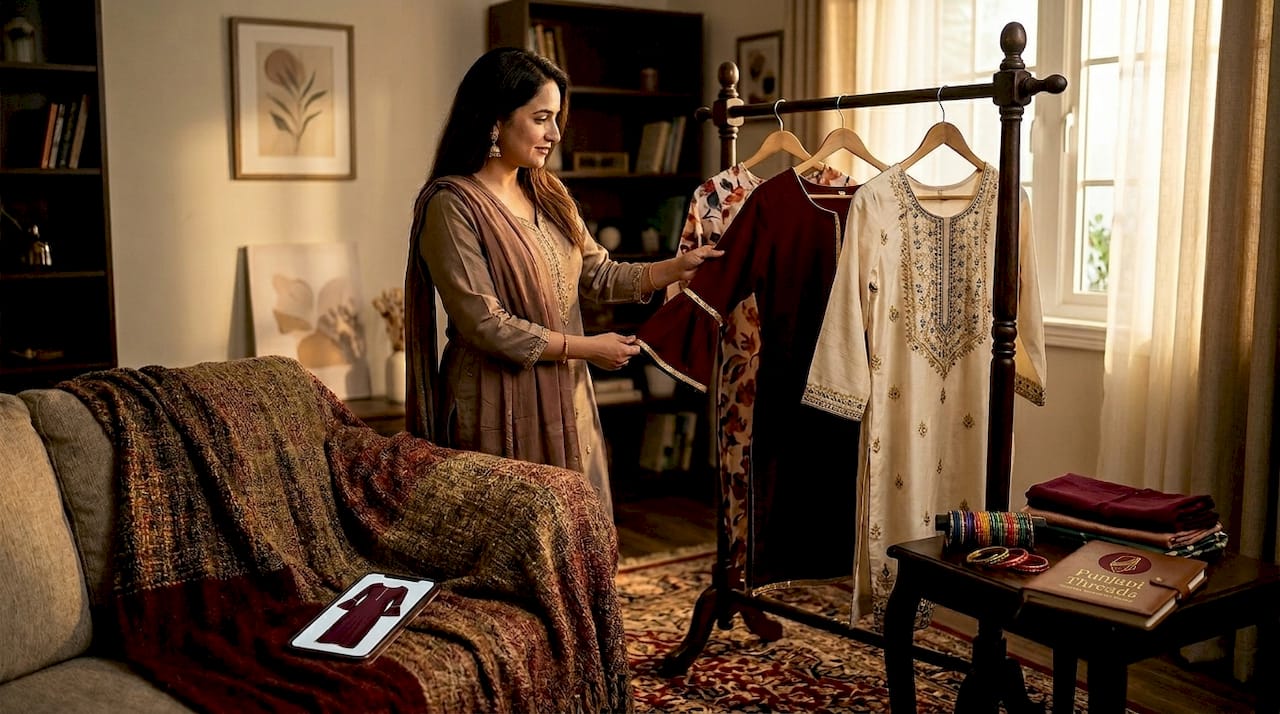
The mistake I see most often is overloading a suit. Heavily embellished sleeves on a heavily embellished body look cluttered, not rich. My instinct, developed through watching what actually photographs well and what reads well in person, is always to let one element carry the drama. If the sleeve is doing something extraordinary, the body should be doing very little.
I also think the fear of modern sleeve styles in traditional contexts is overblown. A cold shoulder kameez in the right fabric at a mehendi is not disrespectful. It’s confident. The custom vs. ready-made decision matters here too. Custom stitching gives you control over sleeve fit and proportion that no off-the-rack option can reliably deliver. If a sleeve style genuinely excites you, have it made to your measurements. That’s when it truly works.
— Punjabi
Explore Punjabithreads’ custom sleeve designs
When the sleeve is what you’re building the outfit around, getting the construction right matters as much as choosing the right design.
At Punjabithreads, every kameez is stitched to your exact measurements with your choice of fabric and sleeve design. Whether you’re drawn to classic bell sleeves in embroidered georgette or modern sheer sleeves in organza, the team brings that vision to life with precision. Their tailoring process includes a fitting stage specifically to finalize sleeve length and fit, so you’re never guessing at proportions. From festival-ready traditional suits to contemporary styles that blend cultural heritage with global fashion, you’ll find Punjabi suits in Melbourne designed for real occasions and real body shapes. If you know what you want in a sleeve but need help executing it, this is where to start.
FAQ
What are the most popular sleeve styles for Punjabi kameez?
Bell sleeves, straight full-length sleeves, and three-quarter sleeves remain the most consistently popular choices, with sheer and ruffle styles growing quickly in 2026.
Which sleeve style suits short or petite frames best?
Three-quarter sleeves or fitted straight sleeves work well for petite frames because they avoid adding volume at the arm that could shorten the overall silhouette.
How does sleeve embellishment affect fabric choice?
Heavier embellishments like gota patti suit structured fabrics like silk and velvet, while chikankari and light hand embroidery pair best with softer fabrics like chiffon or lawn to preserve drape and movement.
Should I get my kameez sleeves tailored even if it fits well overall?
Yes. Proper sleeve fit at the armhole and wrist significantly affects the finished look, and sleeve length adjustments are among the most common alterations even on well-fitting garments.
Can modern sleeve styles like cold shoulder work for traditional Punjabi occasions?
Yes, when chosen thoughtfully. Cold shoulder styles in traditional fabrics and colors read as contemporary while still honoring the Punjabi kameez silhouette, making them appropriate for functions like mehendi or Vaisakhi celebrations.


